
Why ELV Systems Are Essential for Modern Commercial Buildings
Why ELV Systems Are Essential for Modern Commercial Buildings
Walk into any modern commercial building today, and most of the technology keeping it secure, connected, and efficient operates quietly in the background. Security cameras watch over entrances. Access control systems manage who comes and goes. Intercoms keep occupants connected to security teams. Structured cabling ties every digital service in the building together.
All of this falls under one umbrella: Extra Low Voltage (ELV) systems — the digital backbone of modern commercial infrastructure.
As commercial buildings grow smarter and more technology-driven, ELV systems have stopped being an optional extra. They are now a core part of how buildings operate, supporting security, communication, automation, and business continuity. For property owners and facility managers investing in ELV maintenance services in Abu Dhabi, keeping these systems properly maintained is just as critical as installing them correctly in the first place.
What Exactly Are ELV Systems?
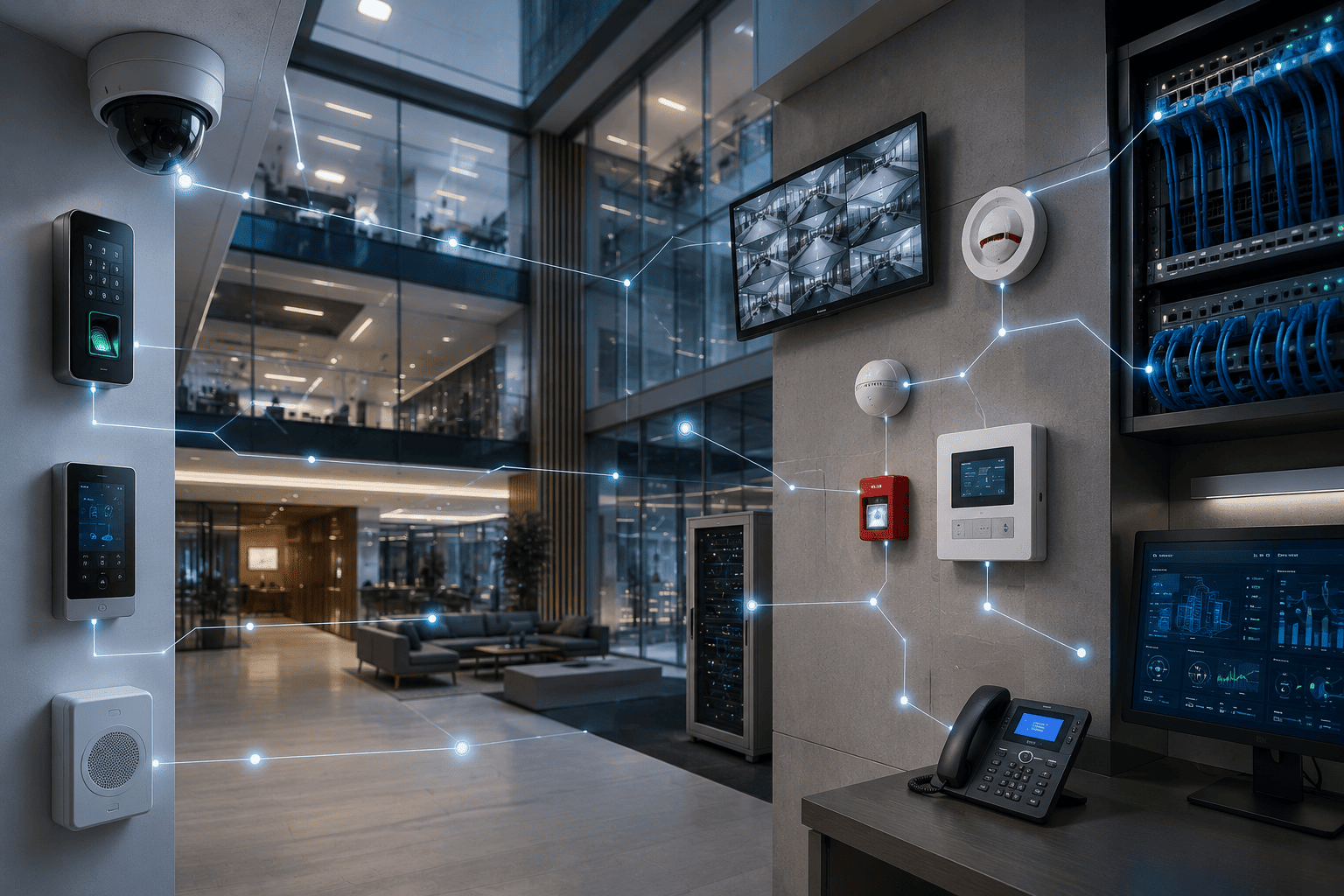
ELV (Extra Low Voltage) systems run at voltages far below standard electrical power supplies, which makes them inherently safer for communication, monitoring, and control applications. Rather than distributing electrical power, they carry information — data, video, audio, and control signals — throughout a building.
A typical ELV infrastructure can include:
- CCTV surveillance systems
- Access control systems
- Intercom and public address systems
- Structured cabling
- Data and networking infrastructure
- Building Management Systems (BMS)
- Audio-visual systems
- Visitor management solutions
- Fire alarm interfaces
Individually, these systems serve very different purposes. Together, they form an integrated network that improves how a building performs, feels, and protects the people inside it.
Why ELV Systems Have Become Essential
Commercial tenants and employees now expect reliable internet, secure workspace access, uninterrupted communication, and a genuinely safe working environment. At the same time, facility managers need real-time visibility into what’s happening across the property so they can respond to issues before they escalate.
ELV systems bring all of these requirements together under a single integrated infrastructure. Instead of running multiple disconnected systems — one for security, one for networking, one for building controls — businesses can manage everything from centralised platforms. That reduces complexity and improves efficiency across the entire property.
As more buildings adopt smart technologies, the role of professional ELV maintenance services in Abu Dhabi keeps growing, ensuring these interconnected systems stay reliable throughout their operational life.
Improving Building Safety and Security
Safety is one of the biggest reasons commercial buildings invest in a well-designed ELV system.
High-definition CCTV cameras monitor entrances, parking areas, common spaces, and restricted zones. Access control systems limit entry to authorised personnel only. Intercom systems keep communication open between occupants and security teams, even during high-traffic periods.
Many ELV systems also integrate directly with fire alarm and emergency notification systems, allowing faster coordination during an emergency. Instead of isolated equipment operating independently, modern buildings benefit from connected systems that share information in real time — which means faster decisions and safer outcomes for employees, visitors, and tenants alike.
This is exactly why many of the leading fire and safety companies in Abu Dhabi now treat integrated ELV infrastructure as a core part of delivering comprehensive building safety solutions, rather than a separate add-on.
The Foundation of Smart Buildings
One of the biggest shifts in commercial real estate is the move toward intelligent, connected buildings.
Offices, hospitals, hotels, shopping centres, and mixed-use developments are increasingly relying on smart technology to improve operational efficiency — and ELV systems make that possible by linking sensors, automation platforms, and digital controls throughout the property.
Building Management Systems (BMS) can automatically adjust lighting, air conditioning, and ventilation based on real-time occupancy and operating conditions. IoT sensors continuously gather data on equipment performance, indoor air quality, and space utilisation.
Instead of reacting to problems after they’ve already caused disruption, smart buildings use the data generated through ELV infrastructure to get ahead of issues and continually optimise daily operations.
Better Connectivity Supports Better Business
Reliable communication infrastructure isn’t just an IT concern anymore — it has a direct impact on business productivity.
Structured cabling forms the physical backbone connecting computers, Wi-Fi networks, telecom systems, security equipment, and cloud-based applications. As more businesses shift to digital-first workflows, dependable networking infrastructure becomes non-negotiable.
Commercial tenants expect high-speed connectivity, reliable meeting room technology, video conferencing that just works, and communication systems that never drop out. Without a properly designed ELV infrastructure, meeting those expectations becomes an uphill battle — which is one reason more organisations are investing in professional ELV maintenance services in Abu Dhabi to keep their communication backbone running without disruption.
Supporting Energy Efficiency and Building Performance
ELV systems also play a significant role in energy management.
When integrated with a Building Management System, low-voltage sensors track occupancy, temperature, lighting levels, and environmental conditions throughout the property. Rather than running HVAC or lighting continuously regardless of actual usage, automated controls adjust performance based on real occupancy data — cutting unnecessary energy consumption while keeping occupants comfortable.
For commercial property owners in Abu Dhabi, where cooling accounts for a substantial share of operational costs, intelligent building automation can translate into meaningful long-term savings. At the same time, these systems support broader sustainability goals by reducing overall resource consumption without sacrificing performance.
Why Regular ELV Maintenance Matters Just as Much as Installation
Installing an ELV system is only the beginning of its lifecycle. Like any critical building infrastructure, these systems need regular inspection and preventive maintenance to keep performing reliably.
Over time, cameras lose image clarity, access control devices develop faults, network cables degrade, and communication equipment can become outdated or misconfigured. Small issues that go unnoticed often snowball into problems that affect security, communication, and day-to-day operations.
Routine maintenance catches potential faults before they turn into unexpected failures. Software updates, equipment testing, cable inspections, and performance checks all contribute to keeping systems running efficiently while minimising costly downtime.
Businesses that invest in professional ELV maintenance services in Abu Dhabi consistently see the payoff: improved system reliability, longer equipment lifespan, and fewer operational interruptions.
Why ELV Systems Matter So Much in Abu Dhabi
Abu Dhabi continues to see rapid growth across commercial developments, business parks, healthcare facilities, hospitality projects, educational institutions, and mixed-use properties. As these buildings get larger and more interconnected, expectations around safety, security, and operational efficiency keep rising.
Developers and facility managers are no longer satisfied with isolated building systems. They increasingly want integrated solutions where security, communication, automation, and monitoring all work together through a single, unified infrastructure.
Local regulations and industry standards also place growing emphasis on life safety, security integration, and reliable building operations. Proper planning, installation, testing, and maintenance all help ensure ELV systems perform as intended while supporting compliance requirements.
That’s why so many organisations choose to work with experienced fire and safety companies in Abu Dhabi — providers who understand how ELV infrastructure complements broader fire safety and facility management strategies, rather than treating it as a standalone service.
Future-Proofing Commercial Buildings
Technology keeps evolving, and commercial buildings need the flexibility to adapt without tearing out and replacing major infrastructure every few years.
A well-designed ELV network gives buildings the flexibility to integrate future technologies — artificial intelligence, predictive maintenance, smart parking, advanced analytics, cloud-based monitoring, and next-generation automation — without a complete overhaul.
When the underlying ELV framework is designed with scalability in mind, businesses can expand and upgrade their systems far more efficiently as new technology becomes available. That protects the initial investment and helps commercial properties stay competitive in a market where digital transformation is quickly becoming the norm, not the exception
Common Challenges Without a Reliable ELV Infrastructure
Many of the operational headaches experienced in commercial buildings trace back to outdated or poorly maintained ELV systems, including:
- Frequent CCTV or surveillance failures
- Unreliable access control systems
- Slow or unstable network connectivity
- Communication breakdowns between integrated systems
- Rising maintenance costs from reactive, last-minute repairs
- Difficulty integrating new smart building technologies
Fixing these problems after the fact almost always costs more than maintaining the systems proactively from day one. Regular servicing minimises these risks and keeps the infrastructure supporting daily operations the way it should.
Choosing the Right ELV Partner
A genuinely effective ELV solution involves far more than supplying equipment. System design, professional installation, testing, commissioning, integration, documentation, and ongoing maintenance all contribute to long-term performance.
Experienced providers understand how different building systems interact with one another, and they design solutions that improve overall operational efficiency — rather than stitching together isolated technologies that become a headache to manage.
For businesses seeking dependable ELV maintenance services in Abu Dhabi, the right provider brings expertise across security systems, networking infrastructure, facility management, and life safety solutions, ensuring every component works together as one reliable ecosystem.
Frequently Asked Questions
What does ELV stand for in building systems?
ELV stands for Extra Low Voltage. It refers to systems that operate at significantly lower voltages than standard electrical power and are used for communication, monitoring, and control rather than power distribution.
How often should ELV systems be maintained?
Most commercial ELV systems benefit from scheduled inspections at least quarterly, with more frequent checks for critical components like fire alarm interfaces and access control hardware. The right interval depends on system complexity and manufacturer recommendations.
Can ELV systems be integrated with existing fire safety systems?
Yes. Well-designed ELV infrastructure is built to integrate with fire alarm and emergency notification systems, allowing faster, coordinated responses during an emergency.
Why is ELV maintenance important even if systems seem to be working fine?
Many ELV faults develop gradually — a camera losing clarity, a cable degrading, firmware falling out of date — long before they cause a visible failure. Preventive maintenance catches these issues early, avoiding costly downtime and security gaps.
Conclusion
ELV systems have become one of the most important foundations of modern commercial buildings. From strengthening security and improving communication to enabling smart building technology and boosting operational efficiency, these systems touch nearly every aspect of how a building performs.
As commercial properties across Abu Dhabi continue adopting intelligent technologies, ELV infrastructure will only become more central to how buildings operate. Businesses that invest in well-designed systems and ongoing ELV maintenance services in Abu Dhabi are better positioned for reliability, business continuity, and long-term adaptability.
Rather than treating ELV as a background support service, building owners should see it for what it truly is: a long-term investment in safety, efficiency, and operational resilience. Partnering with experienced technical specialists and reputable fire and safety companies in Abu Dhabi ensures these critical systems keep delivering value for the full lifecycle of the building.